How to Properly Care for and Maintain Your Challenge Coins
Challenge coins mark service, milestones and membership, and most of them are meant to last a lifetime. The metal, plating and enamel that make a coin beautiful are also what a careless drawer, a sunny windowsill or the wrong cleaning product will slowly ruin. This guide explains how to clean, store, display and protect challenge coins so they look the way they did on the day they were presented.
Quick answer: give every coin its own holder, keep the collection indoors away from moisture and direct sunlight, handle coins by the edges with clean, dry hands, and clean only when necessary with mild soap and warm water. Never use metal polish, abrasives, household acids or ultrasonic cleaners. Photograph and record important coins so their story survives along with the metal.
Why does proper care matter for challenge coins?
A challenge coin is usually irreplaceable in a way a store-bought item is not. It records who presented it, when and why. Whether it commemorates military service, a fire or police career, a corporate milestone or a club membership, the sentimental value far outweighs the cost of the metal.
Damage to a coin is almost always gradual. Coins rubbing together in a box leave hairline scratches. Humidity dulls plating and can spot bare metal. Sunlight fades printed artwork and yellows epoxy. Fingerprints etched into a high-polish surface become permanent if they sit for years. None of this happens overnight, which is exactly why a few good habits now prevent most of it.
How do I clean a challenge coin?
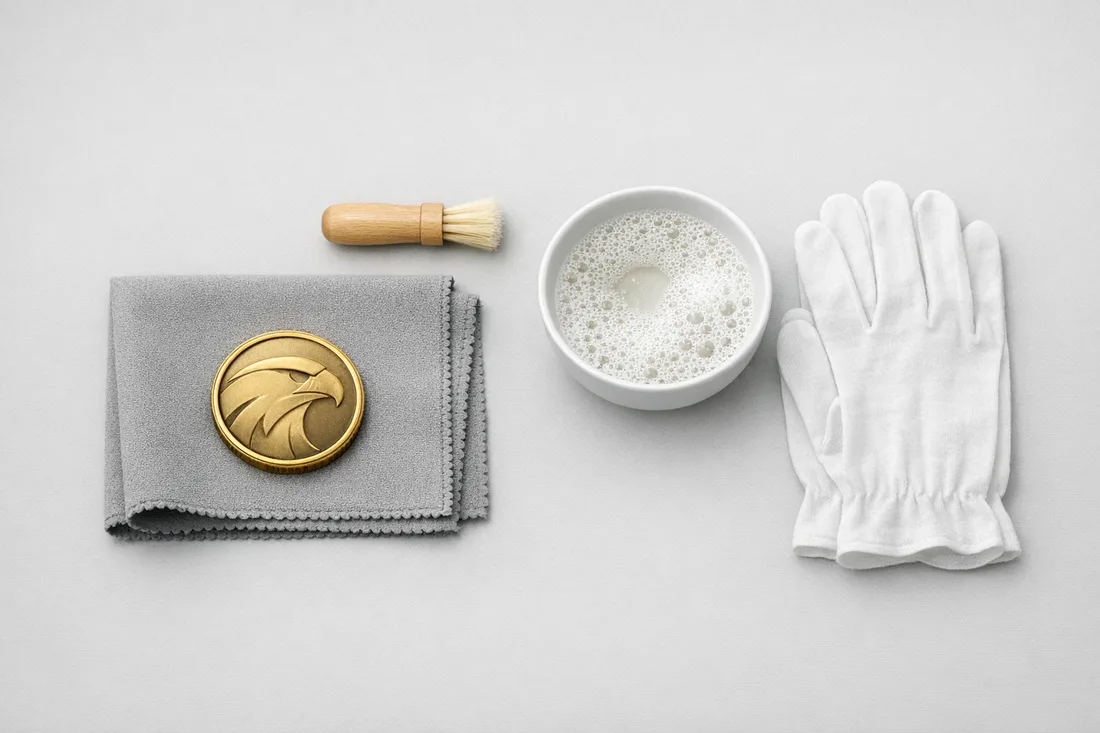
Clean a challenge coin as rarely as possible. Most fingerprints and dust come off with a dry microfiber cloth, and every wet cleaning carries a small risk to plating, enamel and printed surfaces. When a coin genuinely needs washing, you will need:
- A soft microfiber or lint-free cotton cloth
- Mild dish soap with no added lotion, bleach or degreaser
- Warm water, not hot
- A soft-bristle toothbrush for recessed areas (optional)
- Cotton gloves if the coin has a polished finish
Step-by-step cleaning process
-
Add a drop of mild soap to a bowl of warm water and stir until it is lightly sudsy.
-
Dampen the cloth, wring it out and wipe the coin in light, straight strokes. Do not scrub or press hard; pressure is what scratches plating and color enamel .
-
For dirt packed into recessed areas, use the soft toothbrush with almost no pressure and work in small circles.
-
Rinse under clean, warm running water until no soap remains.
-
Pat dry with a fresh cloth, then leave the coin face-up on a towel until it is completely dry. Never seal a damp coin in a capsule or bag.
What should you never use on a challenge coin?
Every product below is either abrasive or acidic. Each one will strip plating, dull enamel, cloud epoxy or permanently remove the dark tone of an antique finish.
| Never use | What it does to a coin |
|---|---|
| Toothpaste | Fine abrasives scratch plating and dull enamel |
| Baking soda | Gritty paste leaves hairline scratches in polished metal |
| Vinegar or lemon juice | Acid etches plating and can discolor bare metal |
| Metal polish | Strips plating and erases the dark tone of an antique finish |
| Jewelry dips | Harsh chemicals attack enamel, epoxy and printed artwork |
| Abrasive pads | Scour the surface and flatten raised detail |
| Ultrasonic cleaners | Vibration loosens enamel and clouds epoxy domes |
| Rock tumblers | Grind away plating and every sharp edge of the design |
If a coin is badly tarnished or corroded, a professional conservator is the safe option.
What is the best way to store challenge coins?
The single most important rule is one coin per holder. Coins that touch each other scratch each other, and every bump of the box makes it worse. Every coin we make ships in its own clear PVC pouch, which handles shipping and distribution well. For coins that will be kept, displayed or presented as gifts, one of our upgraded packaging options gives better long-term protection.
| Option | Best for | Protection it gives | Keep in mind |
|---|---|---|---|
| PVC pouch | Large events, unit distribution, giveaways | Keeps coins separated and scratch-free through shipping and handing out | Free standard packaging; move keeper coins to a capsule for the long term |
| Coin capsule | Polished, valuable or sentimental coins | Hard, clear shell stops scratches and keeps fingers off both faces | The best long-term holder for a single coin |
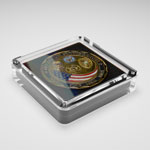
| Acrylic box | Storage and shelf display of one coin | Rigid hard-sided box that shows one face while sealing out dust | Only one side is visible; flip it occasionally |
| Velvet bag | Membership and recognition gifts | Soft fabric prevents scratches and looks the part when presented | No rigid protection; store the bag where it cannot be crushed |
| Velvet presentation box | Awards, retirements, memorials, VIP gifts | Fitted insert holds the coin still and completes the presentation | Keep the box closed and out of direct sun |
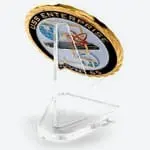
| Coin stand | Desk or shelf display | Lightweight acrylic stand keeps the coin upright and visible | Open to dust, sunlight and curious hands; best for short-term display |
| Magnetic acrylic case | Long-term storage and display of a keeper coin | Sleek, durable clear case that shows the coin and closes securely with a magnet | Wipe the acrylic with a soft cloth only; abrasives will scratch it |


How does the coin's finish change how you clean it?
Not every challenge coin tolerates the same handling. A high-polish gold coin and an antique-silver coin with soft enamel look completely different and age differently too. Match your cleaning habits to the finish.
| Finish | How it ages | Storage and handling advice |
|---|---|---|
| Polished plating | Mirror surface shows every fingerprint and hairline scratch | Capsule it, handle with gloves or by the edge, wipe with a dry cloth only |
| Antique plating | Darkened recesses hide minor marks well | Never polish; polishing lifts the intentional dark contrast out of the recesses |
| Soft enamel | Recessed color pockets collect dust and lint | Dust with a soft brush; the raised metal lines protect the color from rubbing |
| Digital Prints | Ink can fade in sunlight and lift under solvents | No rubbing, no chemicals, no window displays |
| Epoxy dome | Clear coat protects color but can scratch, cloud or yellow | Store in the dark and away from heat; never use abrasives on the dome |



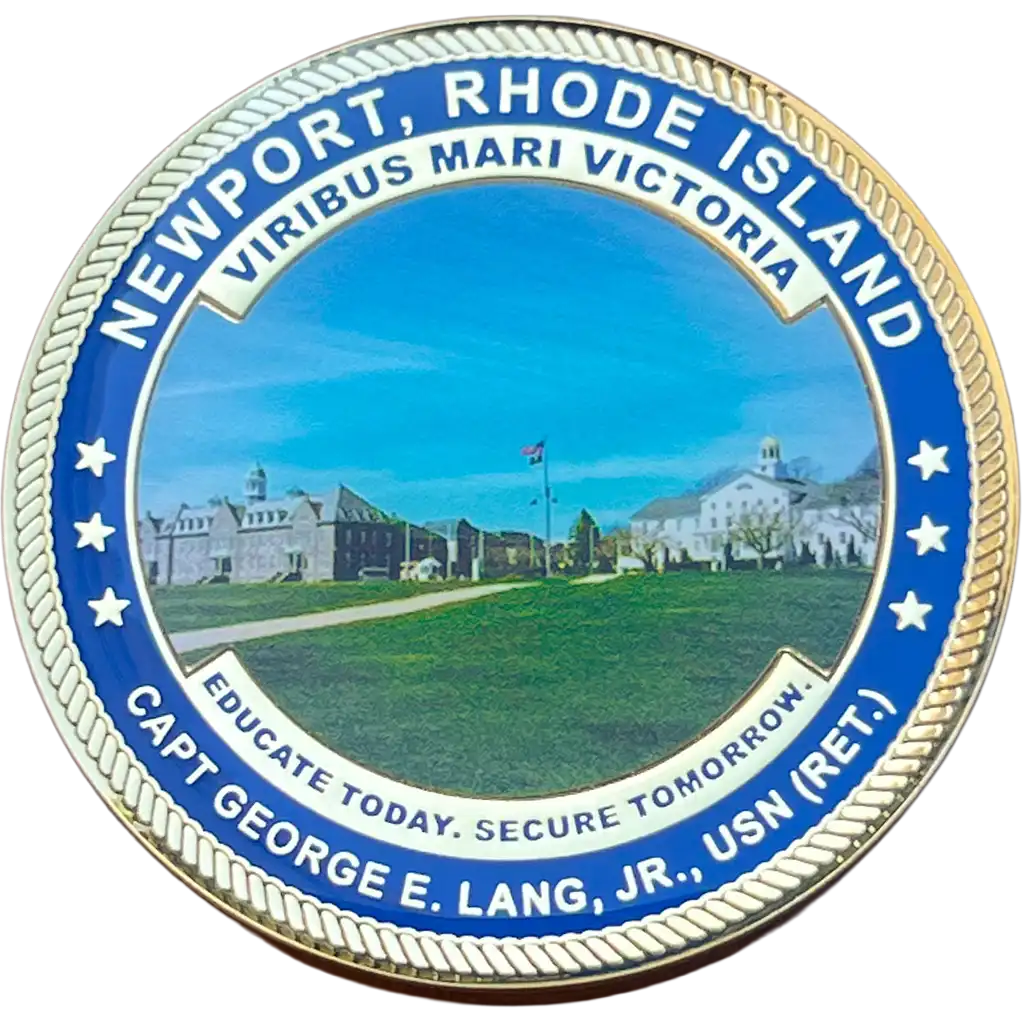

Not sure which finish your coin has? Our guides to plating types and die struck, hard enamel and soft enamel show what each one looks like.
Where should I keep my challenge coins?
Coins belong in the climate-controlled part of your home or office, in a closed container, out of direct light. The worst places are the ones people reach for first: basements, attics, garages, bathrooms, glove boxes, window ledges and the cabinet under the sink. All of them swing in temperature or humidity, and some put the coin inches from a leak or a heat source.
Four things do most of the damage. Here is what to do about each one:
| Hazard | Do | Don't |
|---|---|---|
| Moisture | Keep coins in an enclosed case with a silica gel packet, and replace the packet when it stops feeling dry | Store coins in a basement, bathroom, garage or the cabinet under a sink, where humidity swings and leaks happen |
| Heat | Keep coins in the climate-controlled part of your home or office | Leave coins in a parked car, an attic or next to a radiator or vent; heat softens epoxy and adhesive inserts |
| Light | Display coins on an interior wall or shelf away from windows, and rotate them if the room is bright | Put a display case in direct sunlight; it fades printed color and yellows clear coatings |
| Dust | Use a case that closes securely and dust coins with a soft brush | Leave coins on open shelves, where dust settles into recessed enamel and turns to grime once it meets humidity |
Warning signs that a storage spot is wrong: condensation on the case, a musty smell, damp or wavy packaging, a hazy film on the metal or a white, powdery bloom in the recesses. If one coin shows corrosion, move it away from the others until you know what caused it.
How should I handle challenge coins?
Hold a coin by its edge, between thumb and forefinger, with clean and completely dry hands. Skin oils leave prints that etch into polished plating if they sit long enough. Wear cotton gloves for high-polish or historically important coins. Keep coins away from keys, pocket change and other metal that will scratch them, and never carry a bare coin loose in a pocket or bag. When you set a coin down, put it on cloth or felt, never directly on a hard surface.
How do I display challenge coins without damaging them?
A good display lets you see every coin without any coin touching another. Enclosed wall cases, stable tabletop racks and shadow boxes with individual mounts all work. Whatever you choose, leave enough room to lift any single coin straight out without dragging it across its neighbors, and confirm the case closes securely so dust stays out.
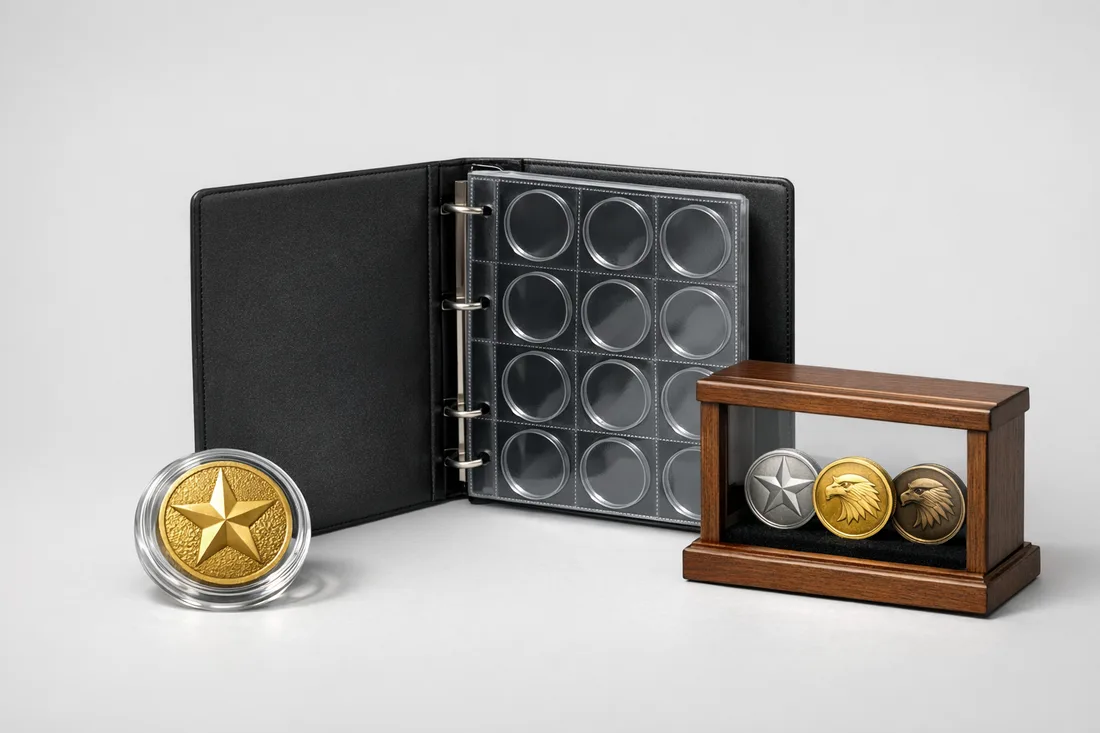
Place the display on an interior wall or shelf away from windows, radiators and vents. Rotate coins occasionally if the case gets any daylight so no single coin takes all the exposure. If the lining is decorative foam or raw wood, add a felt layer or capsule each coin before it goes in.
What are the most common challenge coin storage mistakes?
- Tossing bare coins together in a bowl, drawer or bag, where they scratch each other
- Leaving coins loose in a desk drawer with keys, pens and paper clips
- Setting coins directly on raw wood or decorative foam that gives off acids or adhesives
- Polishing an antique finish and erasing the contrast that made it look good
- Sealing a coin in a capsule or bag before it is completely dry
- Hanging a display case on the wall opposite a sunny window
- Cleaning minor fingerprints over and over, when each pass wears the surface a little
Challenge coin care checklist
Before a coin goes into storage, confirm each of these:
- The coin is clean and completely dry.
- It has its own pouch, capsule or box.
- No bare metal can touch another coin or a hard surface.
- The storage spot is indoors, dry, dark and away from heat and plumbing.
- Important coins are photographed and their details written down.
Preserving Your Challenge Coins for Years to Come
Good coin care is mostly restraint: keep coins apart, keep them dry and dark, and leave them alone unless they truly need cleaning. Follow the habits above and a coin will look the same in thirty years as it did at the ceremony, ready to be passed on with its story intact.
Planning a coin of your own? It helps to know how challenge coins are made and which metal to choose , since both affect how a coin wears over the years. Request a free quote to get started.
FAQ
-
Can I use metal polish to clean my challenge coins?
-
No. Metal polish is abrasive and can strip plating, dull enamel and permanently remove the darkened recesses of an antique finish. Use mild soap and warm water instead, as described in the cleaning steps above, and only when the coin actually needs it.
-
Can I use a coin cleaning machine or ultrasonic cleaner for my challenge coins?
-
No. Ultrasonic cleaners, tumblers and other coin-cleaning machines can loosen enamel, cloud epoxy domes and wear through plating. Household products such as toothpaste, vinegar and baking soda are also abrasive or acidic and should not be used. Gentle hand cleaning is the only method we recommend.
-
Can I leave my coins in the PVC pouch they shipped in?
-
Yes. The clear PVC pouch every coin ships in keeps coins separated and scratch-free, and it is fine for handing out coins, short-term storage and transport. For a coin you plan to keep and display for years, a coin capsule or acrylic box is the better long-term holder because it is rigid, sized to the coin and keeps fingers off the surface.
-
Does a coin capsule need to be airtight?
-
No. A dry, properly sized holder protects a coin better than an airtight seal. If a coin goes into a sealed capsule while it is even slightly damp, the trapped moisture can cause spotting or corrosion. Make sure the coin is completely dry first.
-
Can challenge coins touch each other inside a case?
-
Bare coins should never rest against each other. Metal edges scratch plating and enamel, and stacked coins rub every time the case is moved. Give each coin its own pouch, capsule or box.
-
Can an antique-finish coin be polished?
-
No. The dark tone in the recessed areas of an antique-plated coin is applied on purpose to create contrast, and polishing removes it. Wipe antique coins with a dry cloth only. For a valuable or historically significant piece, ask a professional conservator before doing anything more.
-
How often should I inspect or clean my challenge coins?
-
There is no fixed schedule for cleaning; clean only when a coin is visibly dirty. Inspect an important or institutional collection every three to six months, and check any collection after a move, a change of case or any sign of moisture, odor or surface change.
-
Should I remove my coins from their original packaging for cleaning or storage?
-
If the original box or capsule is clean, dry and fits the coin properly, leave the coin in it. If the packaging is damaged, damp or lets the coin move around, transfer the coin to a coin capsule or acrylic box. Keep the original box, certificate or presentation letter stored separately, with a note linking it back to the coin.
-
What should I do if my challenge coin gets damaged?
-
Stop handling it and do not attempt a home repair. Consult a professional coin conservator or dealer, who can advise whether the coin should be restored or left as is to preserve its history. For a coin you ordered from us, contact us; a replacement can often be struck from your retained mold .
Support Topics
Product